Live Assistant on Website
First version of the assistant launched directly on the university website to support students in real time.
Explore how Post University is creating a next-generation AI assistant platform to serve both students and staff. What began as a fragmented system of disconnected databases is now transforming into one intelligent, unified interface.
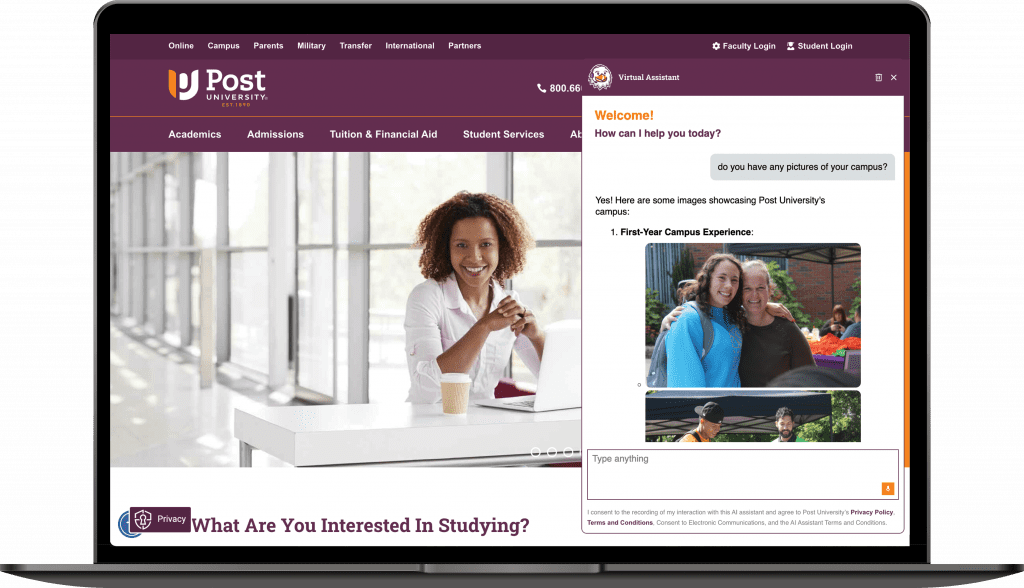
First version of the assistant launched directly on the university website to support students in real time.

All university systems consolidated into a single structured layer, enabling fast deployment of future AI use cases.

Client team can define assistant logic using a visual, code-free framework.
Client
Post University is a private, for-profit university in Waterbury, Connecticut, USA, known for being one of the first institutions to offer full degrees online. They have an internal department responsible for data management and business intelligence.
CHALLENGES
Post University set out with an ambitious vision: to create one intelligent assistant serving both students and staff. Students would get instant answers about tuition, deadlines, or enrollment. Staff could ask real-time questions about leads, budgets, or engagement – and get answers in plain language.
But before they could build that future, they had to confront several critical obstacles that had accumulated over the years:
Student, academic, and administrative data were scattered across multiple platforms. There was no unified access point, which made automation and intelligent services nearly impossible to implement.
Students often had to contact multiple departments to get answers to even basic questions. This created delays, duplicated effort, and a disjointed user experience.
Without a centralized logic or response system, handling recurring queries meant starting from scratch each time. The lack of process standardization made any form of automation difficult to scale.
Earlier attempts at automation relied on rigid, predefined logic that couldn’t be modified without technical intervention. As a result, internal teams were locked out of making even small improvements.
Staff lacked quick, reliable access to key operational metrics like enrollment numbers or lead performance. Generating such reports required time, coordination, and manual effort – slowing down decision-making.
SOLUTIONS
The first phase focused on organizing and centralizing data from across the university. Over the course of several months, we worked with the client to unify key systems and prepare a consistent, structured environment. This foundational layer now supports all current and future AI-driven use cases.
We designed and implemented the first version of the assistant, which is now live on the university website. The logic and user flows were developed in close collaboration with the client, who provided key insights into student needs, frequently asked questions, and service expectations. This ensured the assistant addressed real challenges from day one.
One of the client’s top priorities was long-term independence in maintaining and expanding the assistant. To meet this need, we embedded Dify — a no-code configuration framework that allows internal teams to define new flows and update existing ones – without relying on developers. The client now actively uses this tool to manage dialogue logic on their own.
Where off-the-shelf solutions fell short – such as in pulling live data from internal systems – we developed custom modules and embedded them into the assistant’s architecture. These integrations were built in collaboration with the client’s technical team to ensure alignment with internal data models and access rules.
From the beginning, the assistant was designed with modularity and scalability in mind. The architecture supports future extensions for internal staff use cases—such as querying enrollment data, monitoring budget status, or tracking lead performance—using natural language. This flexibility positions the assistant as a long-term platform, not a one-off tool.
The entire implementation was carried out in close partnership with the client. Weekly feedback loops and planning sessions helped align business needs with technical execution, ensuring that the assistant evolved iteratively and remained grounded in real operational context.
RESULTS
The assistant is now supporting thousands of online students directly on the university website: answering questions, guiding navigation, and reducing support load.
Multiple systems have been consolidated into one consistent data environment, enabling faster development, better accuracy, and seamless integration with AI tools.
Using a no-code visual editor, the client’s team can now independently configure and maintain the assistant’s logic – without relying on developers.
The assistant supports both voice and text-based interaction, improving accessibility and creating a more natural, conversational experience.
Built with modularity in mind, the assistant’s architecture is already prepared to support internal staff needs — such as querying enrollment, tracking budgets, and monitoring lead performance.
Rather than a one-off tool, the assistant represents a long-term shift toward AI-first campus operations — centralizing access to data and services across departments.
WHAT’S NEXT
Post University sees the assistant as a strategic, long-term investment. The next phase will focus on expanding its capabilities to support internal teams—allowing staff to query real-time data on enrollment, lead generation, or budgets using natural language.
Further enhancements may include integrations with reporting dashboards, analytics tools, and even voice-driven interfaces to support daily operations across departments.






AI SOLUTIONS WE’RE PROUD OF
We have helped clients from various industries achieve their goals and meet even the most ambitious business goals.